Early Intervention for Children on the Autism Spectrum: What It Means, Why It Matters, and Where to Start in Jordan
What specialists mean by early intervention, its essential components, and how a family in Jordan takes the first step.
We help every learner express themselves and understand others, through words, signs, pictures or assistive devices.
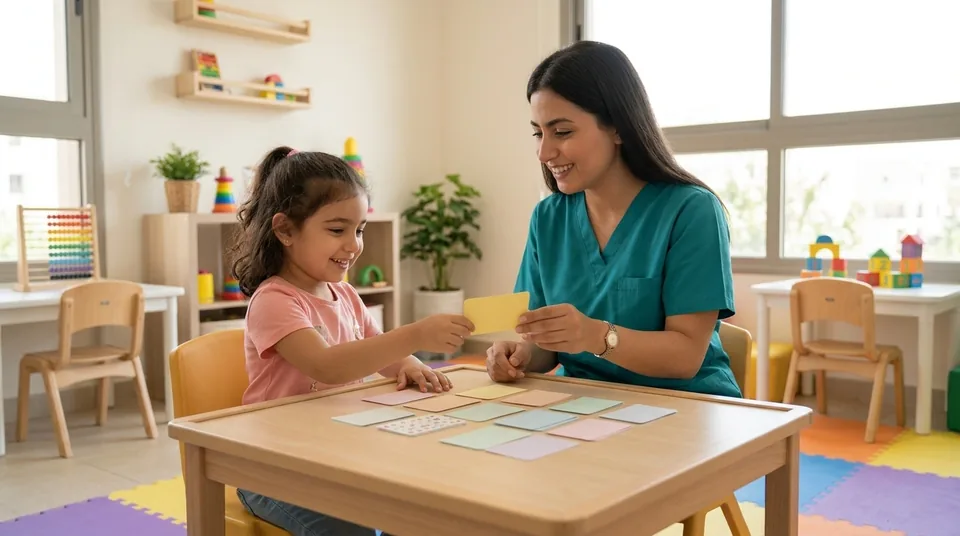
Communication is every child's right, and not all communication is speech. At Ostathna in Amman we help children with delayed speech or language, and children with autism spectrum disorder and social communication difficulties, to gain an effective way of expressing their needs, feelings and ideas, and to understand and interact with others.
We focus on functional communication that genuinely changes a child's day: requesting objects and activities, refusing acceptably, getting attention, commenting and sharing, understanding instructions and questions, then conversation and social skills. Together with the family we choose the mode that fits each child: spoken language, or augmentative and alternative communication (AAC) systems such as picture exchange, signs and speech-generating devices, which the evidence shows support speech development rather than hinder it.
The service is delivered through one-to-one sessions and hands-on parent coaching, because most communication opportunities happen at home, in nursery and at school, not in the session room.
Step by step
We measure comprehension, expression and social communication in natural play and interaction, and listen to the family in detail.
With the family we decide the communication mode to start with, and set functional goals with an immediate effect on the child's life.
Structured teaching of requesting, expressing and conversation within favourite activities, counting independent communication initiations in every session.
We train parents and teachers to create communication opportunities and respond to them, so the child uses new skills all day long.
Can't find your question? Call us and we'll answer directly.
No. Research shows that AAC systems do not hinder speech and often support it, because they give the child a tool to succeed at communicating now.
Yes. Social communication, conversation and understanding social situations are a core part of our work, not only speech delay.
Our service focuses on functional and social communication and on AAC, that is, on the child using what they have to communicate effectively now. When specialist speech or language intervention is needed, we coordinate with speech-language therapists within one plan.
Start by creating opportunities: keep favourite things in sight but out of reach, wait, then respond immediately to any attempt to communicate. We coach you on these strategies in detail as part of the plan.
What specialists mean by early intervention, its essential components, and how a family in Jordan takes the first step.
Early signs worth noticing, and why early intervention makes such a difference.
The first assessment session identifies needs and priorities, then we suggest the most suitable plan.